
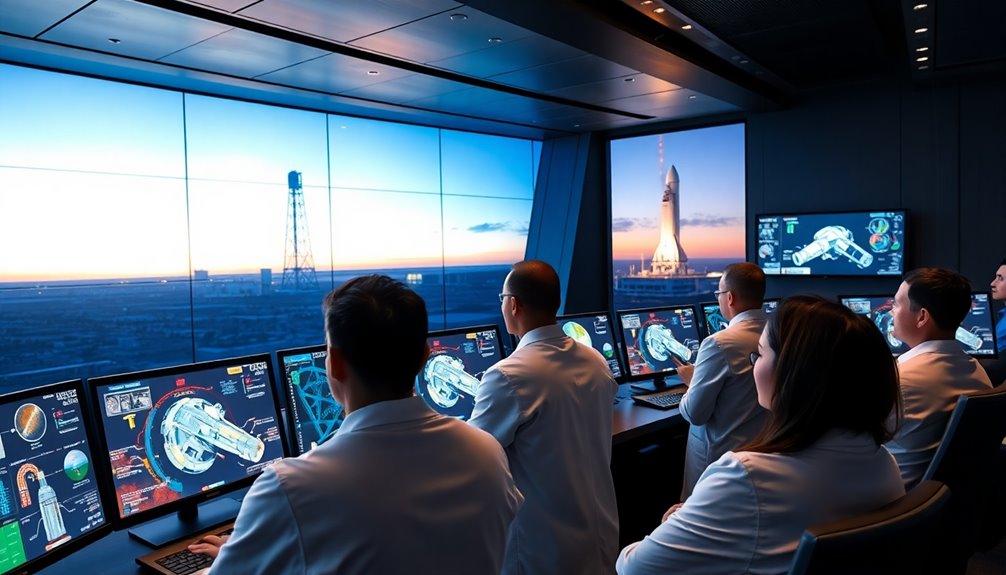
Space agencies are strategically planning next-generation missions. They aim to establish a sustainable human presence on the Moon, focusing on lunar resource utilization and innovative extraction technologies. Concurrently, ESA’s Mars projects involve advanced rovers designed to analyze the Martian environment, emphasizing international collaborations. Private companies are revolutionizing space exploration with developments in reusable rockets and space tourism. Technological advancements in AI and autonomous systems improve mission efficiency, setting the stage for exciting future initiatives in space exploration. More awaits discovery in this evolving terrain.
Article Highlights
- Space agencies are focusing on sustainable lunar missions to establish a human presence and utilize lunar resources for long-term habitation.
- ESA’s Mars projects aim to analyze the Martian atmosphere and assess the planet’s potential for life through advanced robotics.
- Private companies are driving innovation in space tourism and developing reusable rockets, complementing governmental exploration efforts.
- Technological advances, including AI-driven systems and advanced propulsion, are enhancing mission efficiency and planning for future space endeavors.
- International partnerships are fostering collaboration on joint missions, pooling resources to accelerate advancements and reduce exploration costs.
The Vision: Upcoming Lunar Missions and Their Goals
As space agencies prepare for a new era of exploration, upcoming lunar missions aim to establish a sustainable human presence on the Moon. Central to this vision is lunar resource utilization, which seeks to leverage the Moon’s materials to support long-term habitation. Innovations in extraction and processing technologies will enable astronauts to utilize regolith for construction and life support systems. Concurrently, moon base construction is set to redefine human capabilities in extraterrestrial environments. These bases will serve as hubs for scientific research, technology testing, and further exploration of deeper space. Collaborations among international space agencies will improve resource-sharing and knowledge exchange, creating a robust framework for future lunar endeavors. This concerted effort positions humanity to thrive beyond Earth.
ESA’s Mars Projects and Collaborations
ESA is spearheading a series of ambitious Mars projects aimed at unraveling the mysteries of the Red Planet. Central to these initiatives is the ExoMars Rover, designed to analyze the Martian atmosphere and collect Mars samples for future return missions. ESA collaborations with international space agencies broaden the scope and impact of these endeavors, leveraging advancements in space robotics to guarantee mission sustainability. Through rigorous scientific objectives, ESA seeks to deepen comprehension of Mars’ potential for life and contribute to planetary defense strategies. These integrated efforts represent a transformative approach to exploring Mars, positioning ESA at the forefront of interplanetary research and innovation, ultimately paving the way for humankind’s future on the Red Planet.
Private Companies Revolutionizing Space Exploration
Although traditional space agencies have laid the groundwork for exploration, private companies are now reshaping the environment of space travel and research. These innovative enterprises are pioneering space tourism, making it increasingly accessible to adventurous civilians. Companies like SpaceX and Blue Origin are leading the charge, developing reusable rockets that considerably reduce costs and increase launch frequency. Additionally, the rise of commercial satellites is transforming global communications and data collection, enabling real-time analytics and improved connectivity. By utilizing advanced technology and agile business models, these private entities are not only complementing governmental efforts but also hastening advancements in space exploration. As they continue to push boundaries, the future of space travel appears more dynamic and promising than ever before.
Technological Advances Fueling Next-Gen Missions
** Technological advances are playing an essential role in shaping the future of space missions. AI-driven navigation systems improve precision in spacecraft trajectory planning, as advanced propulsion technologies promise faster and more efficient travels through the cosmos. Together, these innovations are revolutionizing how space agencies approach exploration and mission design. Furthermore, machine learning tools are enhancing predictive analytics, enabling more effective mission planning and resource allocation.
AI-Driven Navigation Systems
The integration of AI-driven navigation systems is revolutionizing space exploration, improving both the precision and efficiency of missions. These systems leverage machine learning and autonomous systems to adapt to dynamic environments, enabling spacecraft to make real-time decisions. This innovative approach reduces human intervention, allowing for more complex mission parameters and extended exploration capabilities.
| Feature | Description |
|---|---|
| Autonomous Navigation | Reduces reliance on ground control |
| Real-Time Adaptation | Adjusts routes based on environmental data |
| Improved Safety | Minimizes collision risks |
| Data Analysis | Processes vast amounts of navigational data |
| Mission Optimization | Increases efficiency and resource allocation |
As space agencies adopt these advancements, the future of exploration appears increasingly autonomous and intelligent.
Advanced Propulsion Technologies
As space exploration pushes further into the cosmos, advanced propulsion technologies are becoming vital for improving mission capabilities. Innovations such as plasma propulsion and electric thrusters are transforming spacecraft efficiency, enabling longer missions with reduced fuel consumption. Nuclear propulsion systems promise even greater thrust, facilitating rapid transit to distant planets. Moreover, hybrid engines combine traditional and advanced methods, optimizing performance. Ion drives are particularly effective for deep-space missions, whereas solar sails utilize sunlight for propulsion, offering a sustainable approach. Emerging concepts like space tethers are set to transform orbital mechanics. These advancements, supported by state-of-the-art materials, are fundamental for propelling humanity into a new era of exploration, ensuring that the next generation of missions reaches unprecedented destinations with improved efficiency and sustainability.
International Partnerships in Space Exploration
Even though nations often pursue their own agendas in space, collaboration among international space agencies has become increasingly significant for advancing exploration. Collaborative initiatives, such as joint missions to the Moon and Mars, exemplify the strength of unity in achieving ambitious goals. By pooling shared resources, countries can accelerate technological advancements, reduce costs, and improve scientific outcomes. Projects like the International Space Station demonstrate the effectiveness of international partnerships in nurturing innovation and knowledge exchange. As space agencies navigate complex challenges, such as climate monitoring and deep space exploration, the synergy created through these alliances will be vital. Furthermore, the integration of data-driven strategies will enhance decision-making processes in future missions. In the end, nurturing a collaborative spirit in space exploration not just strengthens global ties but also propels humanity toward a sustainable and prosperous future in the cosmos.
Inspiring Future Generations in Space Science
Inspiring future generations in space science requires a multifaceted approach that engages young minds and fuels their curiosity. Space agencies are increasingly prioritizing youth engagement through innovative educational programs that spark interest in STEM fields. By providing hands-on experiences such as workshops, interactive simulations, and mentorship opportunities, organizations can cultivate a passion for exploration among students. Partnerships with schools and community organizations further improve these initiatives, ensuring that space science reaches diverse demographics. Moreover, leveraging digital platforms allows for global participation, breaking geographical barriers and encouraging collaboration. As young individuals immerse themselves in these initiatives, they become empowered to envision careers in space exploration, eventually driving the next wave of innovation in this dynamic field. Additionally, fostering passive income streams can enable aspiring scientists to pursue their education and career goals without the burden of financial dependence.
Frequently Asked Questions
How Are Space Missions Funded and Budgeted?
Space missions are funded through a combination of government budgets, private investments, and international collaborations. Budget allocation typically involves detailed proposals justifying expenses, emphasizing innovation and potential scientific breakthroughs. Funding sources can include national space agencies, commercial partnerships, and grants from research institutions. As priorities shift, agencies increasingly seek alternative funding avenues, promoting a competitive atmosphere that encourages novel approaches to exploration as they address fiscal constraints and public interest in space endeavors.
What Role Do Astronauts Play in These Missions?
In the shadow of the unknown, astronauts emerge as pivotal figures in space exploration. Their rigorous astronaut training equips them for diverse mission roles, balancing state-of-the-art technology development with the intricacies of team dynamics. They prioritize astronaut health as they traverse the vastness of space, forging international cooperation to tackle shared challenges. Each mission becomes a canvas for groundbreaking research priorities, where their expertise transforms potential into reality, propelling humanity toward the cosmos.
How Are Space Agencies Selected for Collaboration?
Space agencies are selected for collaboration based on established collaboration criteria, which include expertise, technological capabilities, and prior successful agency partnerships. These factors guarantee that participating agencies can effectively contribute to innovative missions. Moreover, the potential for shared resources, research goals, and international interests further influences selection. By cultivating diverse partnerships, agencies improve their collective ability to tackle complex challenges and push the boundaries of exploration and discovery in space.
What Environmental Impacts Do Space Missions Have?
Space missions resemble fiery comets streaking through the cosmos, leaving both wonder and consequences in their wake. Rocket emissions contribute to atmospheric pollution, whereas the increasing orbital debris poses risks to future exploration. Furthermore, resource consumption for launches and equipment can strain Earth’s ecosystems. Nonetheless, these missions likewise improve environmental monitoring capabilities, enabling better comprehension of climate change and biodiversity, thereby balancing innovation with the responsibility of protecting our planet’s fragile environment.
How Are Mission Failures Handled and Analyzed?
Mission failures are systematically addressed through failure analysis, focusing on data interpretation to identify the root cause. Teams employ a collaborative approach, utilizing advanced technologies and methodologies to dissect the incident. Insights gained from this process inform mission recovery strategies, ensuring future endeavors are resilient and innovative. By nurturing a culture of learning, agencies improve their operational frameworks, ultimately propelling advancements in space exploration and technology development.